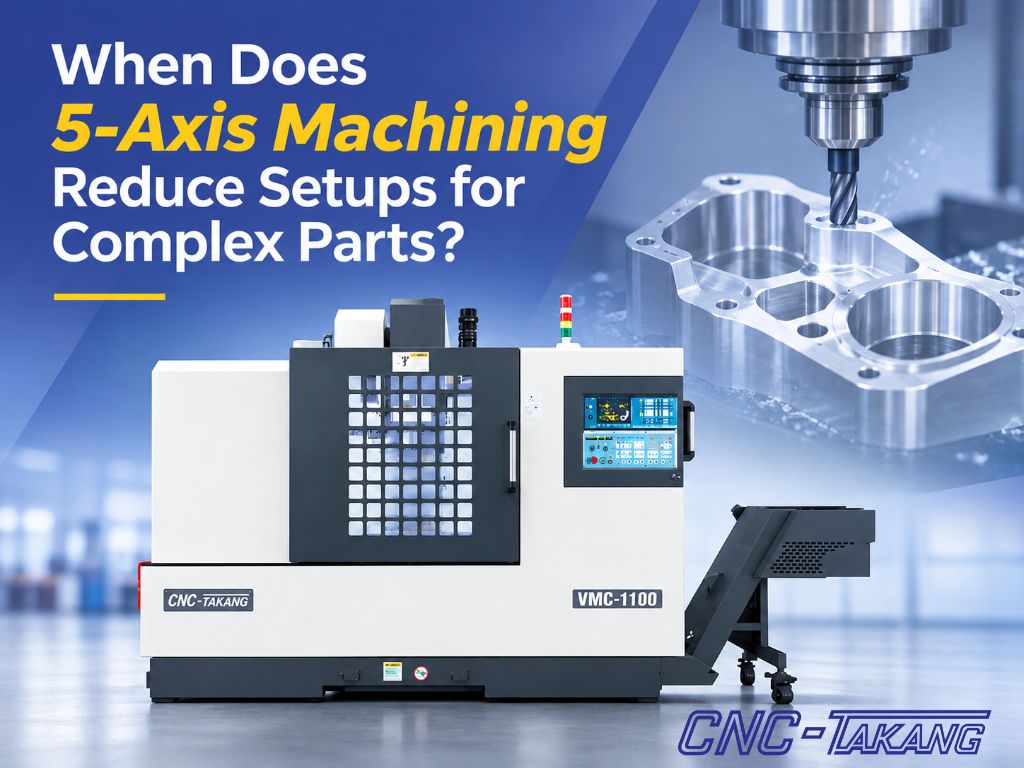
For manufacturers producing complex components, one of the biggest sources of machining time is not always cutting itself.
It is repositioning the workpiece.
A conventional 3-axis process may require a part to be removed, rotated, re-clamped, re-zeroed, and inspected several times before all required surfaces can be machined. Every additional setup adds non-cutting time and creates another opportunity for positioning variation.
This is where 5-axis machining can provide a real advantage.
By allowing the cutting tool and workpiece to approach each other from multiple orientations, a 5-axis machining center can often machine several faces, angled features, and complex surfaces without repeatedly removing the part from its fixture.
However, not every complex-looking part requires simultaneous five-axis machining.
In some applications, a conventional vertical machining center equipped with a rotary or indexing solution can already reduce manual repositioning and provide access to additional workpiece faces.
The real question is: When does reducing setups create enough improvement in accuracy, cycle time, tool access, and process control to justify multi-axis machining?
Table of Contents
- What Does “Fewer Setups” Actually Mean?
- Which Parts Benefit Most From Multi-Axis Machining?
- How Multiple Setups Create Accumulated Error
- When Can Fewer Setups Reduce Cycle Time?
- 3+2 Machining vs. Simultaneous 5-Axis Machining
- Why Tool Access Matters for Complex Parts
- When 3-Axis Machining May Still Be the Better Choice
- How CNC-TAKANG VMCs Support Multi-Directional Machining
- How to Decide Which Machining Configuration You Actually Need
1. What Does “Fewer Setups” Actually Mean?
A setup is more than simply putting a workpiece on the machine.
Every time a part is repositioned, the operator may need to:
- Remove the workpiece
- Clean the fixture and locating surfaces
- Rotate or reposition the part
- Clamp it again
- Establish a new work coordinate
- Verify alignment
- Recheck critical dimensions
- Run the next machining operation
For a simple plate that only requires machining on one or two faces, this may not create a significant problem.
For a complex component requiring machining on four or five sides, however, setup time can become a substantial part of the total production process.
Multi-axis machining changes the question from:
“How do we remove and reposition this part for the next feature?”
to:
“How many required features can we reach before the workpiece needs to be removed from the fixture?”
2. Which Parts Benefit Most From Multi-Axis Machining?
The strongest candidates are generally workpieces with features that cannot be efficiently reached from one vertical spindle direction.
Typical examples include:
- Parts requiring machining on several sides
- Angled holes
- Inclined mounting faces
- Compound angles
- Complex contours
- Deep cavities
- Mold and die components
- Precision housings
- Components with multiple related datums
- Parts requiring side drilling or milling
Consider a component with a top face, two side faces, several angled holes, and an inclined mounting surface.
On a conventional 3-axis machine, the operator may need to machine the top, remove the part, rotate it, locate it again, machine one side, and repeat the procedure for the remaining features.
With an appropriate rotary, indexing, or 5-axis configuration, several of these orientations may become accessible without repeatedly removing the workpiece.
This can simplify both machining and inspection.
Complexity Alone Is Not Enough
A part should not be moved to five-axis machining simply because its geometry appears complex.
The more useful questions are:
- How many setups are currently required?
- How difficult are those setups?
- Are critical tolerances transferred between setups?
- Is tool access currently causing problems?
- How much operator time is spent repositioning the workpiece?
If these issues are significant, multi-axis machining becomes much more valuable.
3. How Multiple Setups Create Accumulated Error
Reducing setups is not only about saving labor.
It can also reduce the number of datum transfers required during production.
Suppose a hole on Side B must maintain a precise relationship to a reference surface machined on Side A.
If those features are produced in different setups, the final relationship may depend on:
First machining setup + fixture repeatability + repositioning + new work offset + second machining setup
Each individual variation may be small, but the final component reflects the combined effect of the entire process.
This becomes particularly important when parts require:
- Tight positional tolerances
- Related holes on different faces
- Intersecting bores
- Angular features
- Multiple precision datums
- Consistent batch-to-batch repeatability
If several related features can be machined while the workpiece remains referenced from the same clamping condition, fewer datum transfers are required.
Fewer Setups Do Not Mean Zero Error
Multi-axis machining does not eliminate the need for accuracy control.
Results still depend on:
- Machine geometry
- Rotary-axis positioning
- Machine calibration
- Fixture accuracy
- Tool measurement
- Thermal stability
- Workpiece probing
- CAM programming
The advantage is therefore not “perfect accuracy.” It is the opportunity to remove some of the variables introduced every time the workpiece is repositioned.
4. When Can Fewer Setups Reduce Cycle Time?
Multi-axis machining can reduce total production time when the time saved from re-clamping, repositioning, probing, inspecting, and moving parts between operations exceeds the additional machine and programming requirements.
Consider a workpiece requiring four orientations.
A traditional process may look like:
A suitable multi-axis process may reduce this to:
The time savings are not limited to machining.
Reducing setups may also decrease:
- Fixture preparation
- Manual alignment
- Work-offset setting
- Intermediate inspection
- Workpiece transportation
- Work-in-process inventory
- Operator involvement
- Risk of incorrect loading
This is why rapid traverse or cutting feed alone does not determine productivity.
A machine can spend additional time rotating or indexing the workpiece and still deliver a shorter total production cycle if several manual setups are removed.
Setup Reduction Becomes More Valuable When:
- The workpiece has many machined faces
- Fixture setup takes significant time
- Alignment must be carefully verified
- Batch production repeats the same process
- Tolerances between different faces are important
- Skilled operator availability is limited
5. 3+2 Machining vs. Simultaneous 5-Axis Machining
Not every part that benefits from additional machining orientations requires simultaneous 5-axis machining.
This distinction is important when choosing equipment.
3+2 / Indexed Machining
In 3+2 machining, rotary axes position the workpiece or cutting direction at a required angle.
Once the position is reached, the rotary axes remain fixed while the linear X, Y, and Z axes perform the cut.
This approach is useful for:
- Multiple-side machining
- Angled holes
- Inclined surfaces
- Features located on different faces
- Reducing manual workpiece rotation
For many prismatic components, this may already provide a major improvement over repeated manual setups.
Simultaneous 5-Axis Machining
In simultaneous 5-axis machining, linear and rotary axes move together during cutting.
This becomes more relevant for:
- Freeform surfaces
- Complex contours
- Continuously changing tool angles
- Blade- or impeller-type geometry
- Complex mold surfaces
- Applications where tool orientation must change throughout the toolpath
The decision therefore should not simply be:
“3-axis or 5-axis?”
It should be:
“Does the component need additional indexed orientations, or does the cutting path itself require continuous simultaneous multi-axis motion?”
This distinction can prevent manufacturers from investing in more machine complexity than their parts actually require.
6. Why Tool Access Matters for Complex Parts
One of the strongest reasons to use multi-axis machining is tool accessibility.
A conventional 3-axis vertical machining center primarily approaches the workpiece from the spindle direction.
This can become restrictive when machining:
- Deep cavities
- Tall side walls
- Angled surfaces
- Side features
- Complex molds
- Contoured surfaces
Changing the orientation between the workpiece and spindle can provide a more direct tool approach.
Shorter Tools May Become Possible
A difficult-to-access feature may require a long tool extension on a conventional setup.
Long tool overhang can increase:
- Tool deflection
- Vibration
- Chatter
- Surface-finish problems
- Difficulty maintaining dimensional accuracy
Reorienting the workpiece can sometimes allow the same feature to be machined using a shorter, more rigid tool.
Better Tool Orientation
For complex contours, positioning the tool more appropriately relative to the surface can also improve machining conditions.
The purpose of additional axes is therefore not simply to create more machine movement.
It is to provide better access to the geometry being machined.
7. When 3-Axis Machining May Still Be the Better Choice
Not every component should be moved to a multi-axis process.
A conventional vertical machining center may still be the most practical solution when:
- Most machining occurs from one direction
- Only one or two simple setups are required
- Workpiece geometry is mainly flat or prismatic
- Existing fixtures are simple and repeatable
- Tolerance relationships between different faces are not critical
- Current production already meets cycle-time targets
- Additional rotary-axis capability would provide little measurable benefit
Consider a plate requiring face milling, pocket machining, vertical drilling, and tapping.
A 5-axis machine could certainly perform these operations, but additional axis capability may not reduce the actual number of setups or significantly shorten the production cycle.
In that case, a standard VMC can remain the more efficient solution.
8. How CNC-TAKANG VMCs Support Multi-Directional Machining
CNC-TAKANG's Vertical Machining Center Series supports a range of machining requirements, from standard 3-axis operations to applications that require additional workpiece orientations.
For parts that need machining on multiple sides, a VMC can be combined with an appropriate rotary or indexing solution to reduce manual repositioning and improve access to side faces, angled features, and repeated machining orientations.
This type of configuration may be useful when the workpiece requires:
- Machining on several sides
- Repeated angular positioning
- Side drilling or milling
- Reduced manual repositioning
- Better consistency between related features
- More operations completed within one clamping cycle
For example, CNC-TAKANG offers VMC models across different machining envelopes and table capacities, allowing manufacturers to select a machine according to workpiece dimensions, fixture requirements, and production conditions.
Models such as the VMC-650L and VMC-850L are suitable starting points for general vertical machining applications, while larger VMC configurations are available when workpiece dimensions and table-load requirements increase.
However, a VMC equipped with a rotary or indexing table should not automatically be considered a simultaneous 5-axis machining center.
The actual capability depends on:
- Machine configuration
- CNC control capability
- Rotary-axis setup
- Number of controlled axes
- Workpiece envelope
- Rotary-table capacity
- Tool accessibility
- Machining strategy
For a component that only needs indexed access to several faces, this type of VMC configuration may already reduce setup complexity.
If the tool orientation must continuously change during the cut, a full simultaneous five-axis solution may be required instead.
Before Selecting the Configuration
Evaluate:
This makes it easier to determine whether the part needs:
Standard 3-axis machining → Indexed / rotary multi-directional machining → Simultaneous 5-axis machining
rather than automatically moving to the most complex machine configuration.
9. How to Decide Which Machining Configuration You Actually Need
The most reliable way to evaluate multi-axis machining is to begin with actual workpieces—not machine specifications.
Select several representative components and review the current production process.
| Question | Why It Matters |
|---|---|
| How many setups are currently required? | Establishes the potential for setup reduction |
| How long does each setup take? | Identifies actual non-cutting time |
| Which faces require machining? | Determines orientation requirements |
| Are angled features involved? | Indicates whether indexing could simplify the process |
| Are tolerances related across multiple faces? | Reveals datum-transfer concerns |
| Are long tools currently required? | Shows potential tool-access problems |
| How complex are the fixtures? | Helps measure setup difficulty |
| What are the workpiece dimensions and weight? | Determines table and rotary-device requirements |
| Is continuous 5-axis movement required? | Separates indexed machining from simultaneous machining |
| What is the production volume? | Helps determine the economic impact of setup reduction |
A part requiring four setups does not automatically justify a five-axis machine.
But if those four setups require significant operator labor, multiple fixtures, careful alignment, intermediate inspection, and repeated datum transfer, the value of a multi-axis process becomes much greater.
Likewise, if the only challenge is accessing two additional faces, adding an appropriate indexing or rotary solution to a VMC may already address the problem.
Decision Guide
| Production Situation | Configuration to Consider |
|---|---|
| Most features accessible from the top | Standard 3-axis VMC |
| A few additional sides must be machined | VMC + indexing / rotary solution |
| Several fixed angular positions are required | Indexed multi-axis / 3+2 strategy |
| Complex surfaces require continuous tool orientation | Simultaneous 5-axis machining |
| Large, heavy parts exceed conventional VMC capacity | Evaluate a larger VMC or Double Column Machining Center |
Fewer Setups Start With the Right Machining Strategy
5-axis machining can provide substantial benefits for complex components, particularly when multiple workpiece orientations, difficult tool access, and repeated datum transfers are creating production challenges.
But full simultaneous five-axis machining is not always necessary.
For many components, the progression may be:
The correct solution depends on what the workpiece actually requires.
Before investing in additional machine complexity, identify:
- Which setups could be eliminated?
- Which surfaces are difficult to access?
- Which tolerances are affected by repositioning?
- How much time is currently spent on fixtures and alignment?
- Does the toolpath require continuous multi-axis movement, or only additional fixed orientations?
Answering these questions helps manufacturers select a machining solution based on production value rather than axis count.
Need Help Reducing Setups for Complex Parts?
If your current process requires repeated workpiece repositioning, multiple fixtures, or machining from several orientations, send CNC-TAKANG your workpiece drawing, material, dimensions, weight, required machining faces, tolerance requirements, current setup process, and production volume.
CNC-TAKANG can help evaluate whether your application is better suited to a conventional VMC, a VMC equipped with an indexing or rotary solution, or a more advanced multi-axis machining solution.
Related Articles
- What Determines the Real Machining Capacity of a Vertical Machining Center?
Learn how workpiece size, table capacity, spindle capability, tooling, and machine structure determine the practical capacity of a VMC. - Why Your Vertical Machining Center Loses Accuracy and When to Upgrade?
Review the machine, spindle, guideway, thermal, and structural factors that can affect machining accuracy over time. - Top 5 Advantages of Using a Double Column Machining Center
See when large workpieces, high table loads, and reduced repositioning requirements may require moving beyond a conventional VMC.