Blog
Why Your Vertical Machining Center Loses Accuracy and When to Upgrade?
In modern machining environments, maintaining consistent accuracy is critical for ensuring product quality, reducing scrap, and meeting tight tolerance requirements. However, many manufacturers eventually face a common issue: their Vertical Machining Center (VMC) no longer delivers the same level of precision as it once did.
With extensive experience in supplying machining solutions for a wide range of industries, CNC-TAKANG works closely with manufacturers to identify performance gaps in existing equipment and determine when upgrading becomes the most effective long-term strategy. Rather than focusing solely on maintenance, evaluating machine capability against current production demands is often the key to improving overall efficiency.
Common Signs Your VMC Is Losing Accuracy
Before identifying the root cause, it is important to recognize the symptoms of declining machine performance. Many manufacturers begin to notice:
-
Inconsistent dimensional accuracy between batches
-
Difficulty maintaining tight tolerances
-
Poor surface finish or unexpected tool marks
-
Increased reliance on manual adjustments
-
Higher scrap or rework rates
These issues often develop gradually, but over time they can significantly impact both production quality and operational efficiency.
Why Accuracy Declines Over Time
Several factors contribute to accuracy loss in a vertical machining center. While some can be partially corrected, others are related to long-term wear and structural limitations.
1. Spindle Wear and Degradation
Continuous operation leads to gradual wear of spindle components. This can introduce vibration and reduce cutting stability, directly affecting machining precision.
2. Guideway and Ball Screw Wear
Repeated movement over time causes wear in guideways and ball screws, resulting in backlash, positioning errors, and reduced repeatability.
3. Thermal Deformation
Heat generated during machining can cause expansion in machine components. Older machines often lack advanced thermal compensation, leading to dimensional drift during long production runs.
4. Structural Rigidity Limitations
As machining demands increase, machines with insufficient rigidity may struggle to maintain stability. This becomes more evident when machining harder materials or performing heavy cutting operations.
Why Repairs Don’t Always Solve the Problem
When accuracy issues arise, maintenance is often the first step. However, repairs do not always address the root cause of performance decline.
Limitations of repair-based solutions include:
-
Structural fatigue cannot be fully restored
-
Alignment adjustments may only provide temporary improvements
-
Replacing worn components does not upgrade machine design
-
Maintenance costs may continue to increase over time
In many cases, continued repair can delay—but not prevent—the need for a more capable machine.
When It’s Time to Upgrade Your Vertical Machining Center
Rather than focusing only on short-term fixes, manufacturers should evaluate whether upgrading their VMC will provide better long-term value.
Key indicators that an upgrade may be necessary include:
-
Inability to consistently meet tolerance requirements
-
Increasing scrap rates and quality inconsistencies
-
Slower machining speeds compared to newer machines
-
Difficulty handling more demanding materials or geometries
-
Rising maintenance costs and unplanned downtime
When these issues begin to affect production stability, upgrading to a modern vertical machining center can significantly improve both performance and efficiency.
The Advantage of Modern Vertical Machining Centers
Modern VMCs incorporate significant advancements that address many limitations of older machines, including:
-
Improved structural rigidity for stable cutting
-
Advanced spindle systems for higher precision
-
Better thermal control and compensation
-
Faster axis movement and positioning accuracy
-
Compatibility with automation and smart manufacturing systems
These improvements allow manufacturers to maintain consistent accuracy while increasing production capacity.
Vertical Machining Center Solutions from CNC-TAKANG
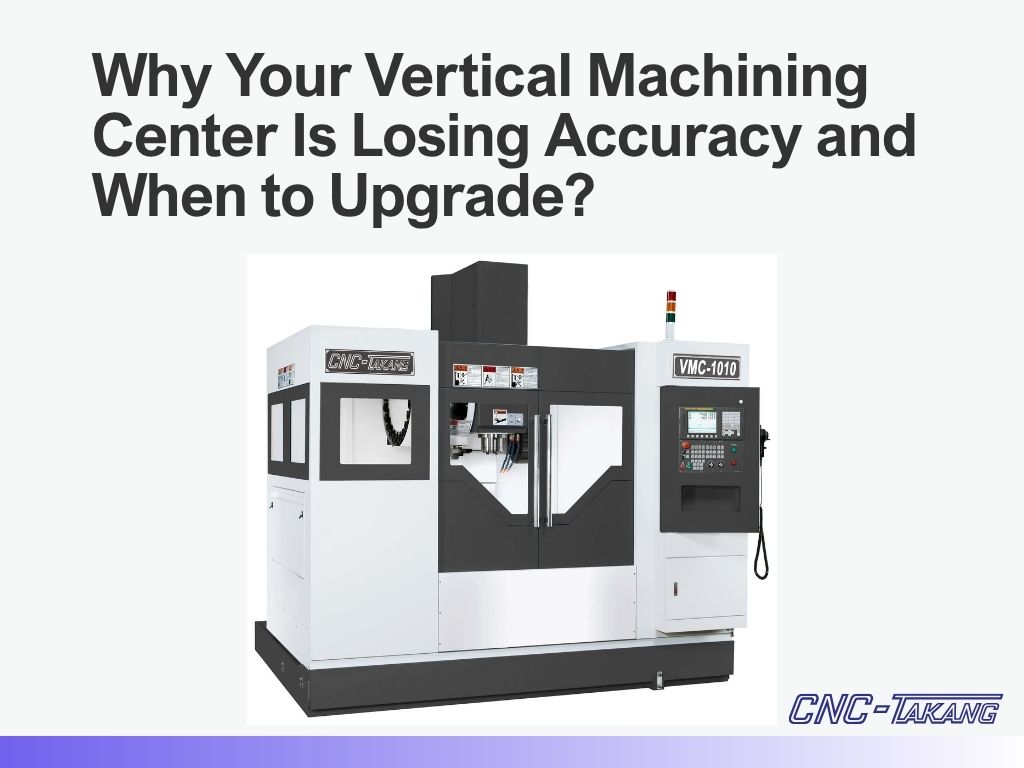
CNC-TAKANG’s Vertical Machining Center series is designed to deliver high precision, stable performance, and flexible machining capabilities across a wide range of manufacturing applications. The product lineup covers multiple machine sizes and configurations, allowing manufacturers to select models based on workpiece dimensions, load requirements, and production needs.
Built with a rigid machine structure and high-quality cast components, CNC-TAKANG vertical machining centers ensure consistent accuracy and stability during high-speed and heavy-duty cutting operations. The machines support a wide range of table sizes and load capacities, making them suitable for everything from general machining tasks to large workpiece processing.
In addition, CNC-TAKANG VMCs can be equipped with rotary tables or indexing systems, enabling multi-directional machining and expanding production flexibility. Combined with reliable spindle performance and efficient machining capabilities, these machines help manufacturers improve productivity while maintaining precise and repeatable results in demanding production environments.
Frequently Asked Questions (FAQ)
Q1: Can machine accuracy always be restored through maintenance?
Not always. While maintenance can improve performance, structural wear and design limitations often prevent full recovery of original accuracy.
Q2: How long does a vertical machining center maintain accuracy?
It depends on usage intensity, material type, and maintenance. Heavy-duty applications may accelerate wear.
Q3: Is upgrading a VMC worth the investment?
In many cases, yes. Upgrading can reduce scrap, improve efficiency, and lower long-term operating costs.
Q4: What is the biggest cause of accuracy loss?
A combination of spindle wear, guideway degradation, and insufficient machine rigidity over time.
Q5: How can manufacturers evaluate machine performance?
By monitoring tolerance consistency, surface finish quality, cycle time changes, and maintenance frequency.
Conclusion
Accuracy loss in a vertical machining center is often a sign that your equipment may no longer meet current production demands. While maintenance can provide temporary improvements, upgrading to a modern machine is frequently the more effective long-term solution.
As machining requirements continue to evolve, selecting the right vertical machining center becomes essential for maintaining quality, efficiency, and competitiveness. CNC-TAKANG works closely with manufacturers to evaluate machining conditions and recommend solutions that align with real production needs.
Contact CNC-TAKANG today to discuss your machining challenges and explore whether upgrading your vertical machining center is the right step for your operation.