Blog
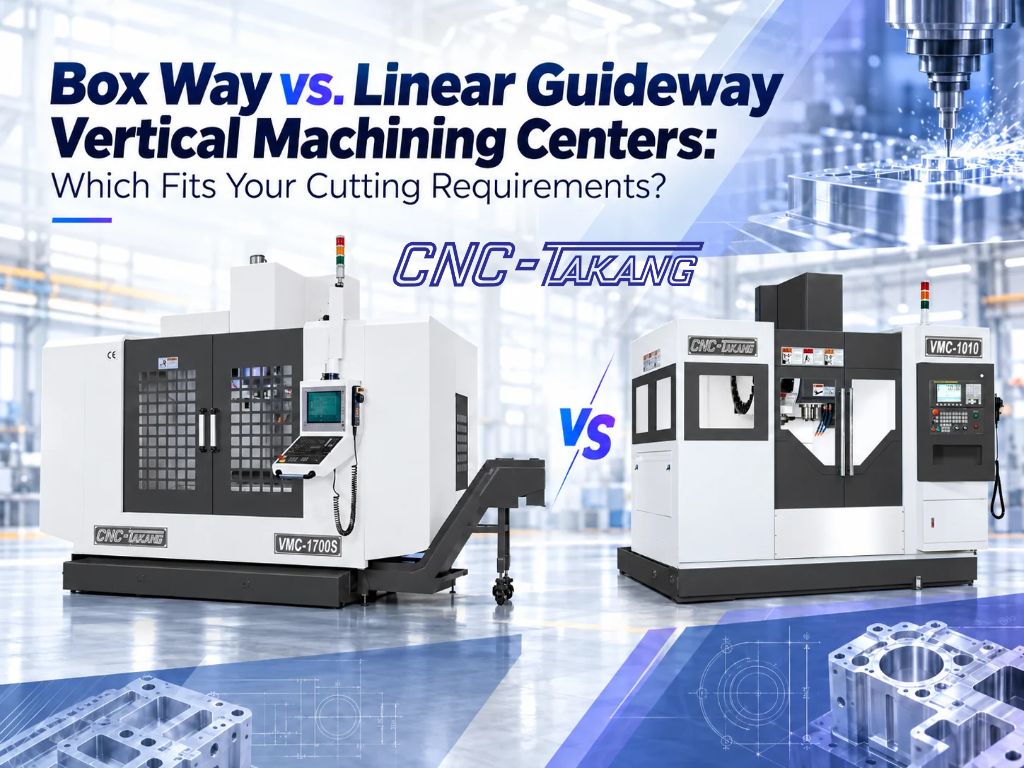
Box Way vs. Linear Guideway Vertical Machining Centers: Which Fits Your Cutting Requirements?
When choosing a vertical machining center, the guideway system directly affects how the machine moves and behaves under cutting loads. Box ways are generally associated with stronger vibration damping and cutting stability, while linear guideways are often selected for lower-friction motion, faster positioning, and responsive axis movement.
However, neither design is automatically better.
A shop performing heavy steel roughing may prioritize rigidity and damping. A manufacturer producing aluminum components with frequent positioning moves may place greater value on rapid traverse and cycle-time efficiency.
The better question is therefore not:
“Which guideway is better?”
It is:
“Which guideway configuration better matches the material, workpiece, cutting load, toolpath, and production cycle?”
Table of Contents
- Box Way vs. Linear Guideway at a Glance
- What Is a Box Way Vertical Machining Center?
- What Is a Linear Guideway Vertical Machining Center?
- When Should You Choose a Box Way VMC?
- When Should You Choose a Linear Guideway VMC?
- Does Box Way Always Mean Better Heavy Cutting?
- Which Guideway Provides Better Accuracy and Surface Finish?
- Box Way vs. Linear Guideway by Machining Application
- CNC-TAKANG Box Way and Linear Guideway VMC Options
- How to Choose Based on Your Actual Workpiece
1. Box Way vs. Linear Guideway at a Glance
The main difference is simple: box ways use sliding contact, while linear guideways use rolling contact. This difference affects friction, damping, axis response, and how each machine behaves under different cutting conditions.
| Factor | Box Way | Linear Guideway |
|---|---|---|
| Contact type | Sliding contact | Rolling contact |
| Friction | Generally higher | Generally lower |
| Vibration damping | Typically stronger | Depends more on guide and machine design |
| Rapid positioning | Generally slower | Generally faster |
| Axis responsiveness | Moderate | Typically higher |
| Heavy cutting | Often preferred | Possible with properly engineered systems |
| Frequent positioning | Less advantageous | Often advantageous |
| Typical priority | Cutting stability and damping | Speed and movement efficiency |
This table is only a starting point. The guideway must always be considered together with the spindle, casting structure, table load, ball screws, servo system, tooling, and workpiece.
2. What Is a Box Way Vertical Machining Center?
A box way vertical machining center uses relatively large sliding surfaces to support and guide axis movement. Its larger contact area generally provides strong structural support and useful vibration-damping characteristics.
This makes box ways particularly relevant when cutting forces are high or when the process requires long periods of stable material removal.
Typical characteristics include:
- Large sliding contact surfaces
- Strong resistance to cutting forces
- Good vibration damping
- High load-support capability
- Stable behavior during demanding cuts
- Higher sliding resistance compared with rolling guides
Because of these characteristics, box-way machines are commonly considered for steel components, molds, large workpieces, and applications involving larger cutting tools or deeper cuts.
CNC-TAKANG's VMC-1100S, for example, uses box slideways on the X, Y, and Z axes as its standard configuration, while a linear-guideway version is available as an option.
The important point is not simply that it uses box ways. Its guideways, casting structure, spindle system, table capacity, and axis design work together as a complete machine.
3. What Is a Linear Guideway Vertical Machining Center?
A linear guideway vertical machining center uses rolling elements between the carriage and guide rail, reducing friction during axis movement.
Lower rolling resistance generally allows faster, more responsive positioning, making linear guideways particularly attractive when the machining cycle includes many rapid movements between cutting locations.
Typical characteristics include:
- Lower friction
- Faster axis response
- Higher rapid-traverse capability
- Efficient acceleration and deceleration
- Smooth repeated positioning
- Strong suitability for machining cycles with frequent non-cutting movement
These characteristics are especially relevant for aluminum components, drilling-intensive parts, multiple-feature workpieces, and higher-volume production.
CNC-TAKANG's VMC-850L uses linear guideways on all three axes. It provides a practical example of a VMC configuration designed around responsive axis movement and general machining efficiency.
For a part involving hundreds of short positioning moves, this type of axis behavior may contribute meaningfully to reducing non-cutting time.
4. When Should You Choose a Box Way VMC?
A box way VMC deserves stronger consideration when cutting stability, vibration damping, workpiece load, and sustained material removal are more important than maximum axis speed.
Typical situations include:
- Heavy steel roughing
- Larger cutter diameters
- Deeper cuts
- Large mold and die components
- Heavy workpieces
- Machine bases and structural components
- Long rough-machining cycles
- Applications susceptible to cutting vibration
Consider a large steel workpiece that requires extensive face milling and pocket roughing.
In this case, saving a few seconds during rapid positioning may contribute much less to total cycle time than maintaining stable cutting conditions throughout hours of material removal.
That is why box ways remain relevant even as linear-guide technology continues to improve.
The real benefit is not simply “strength.” It is the ability to support a machining strategy in which cutting stability matters more than rapid movement between cuts.
5. When Should You Choose a Linear Guideway VMC?
A linear guideway VMC is especially attractive when fast positioning, responsive motion, and reduced non-cutting time have a significant influence on overall productivity.
Typical applications may include:
- Aluminum housings
- General precision components
- Drilling-intensive parts
- Multiple-hole patterns
- Components with many small pockets
- Short-cycle production
- High-volume manufacturing
- Workpieces requiring frequent positioning moves
Consider an aluminum housing with multiple holes, pockets, tapped features, and short toolpaths.
The machine may spend a considerable percentage of each cycle accelerating, positioning, retracting, and moving to the next feature.
In that environment, faster axis movement can have a real impact on cycle time.
This is where linear guideway vertical machining centers can become particularly attractive—not simply because their rapid-feed specification looks better on paper, but because the workpiece actually benefits from that motion profile.
6. Does Box Way Always Mean Better Heavy Cutting?
No. A box-way structure can support demanding cutting conditions, but guideway type alone does not determine heavy-cutting capability.
This is one of the most important distinctions when comparing machines.
Actual heavy-cutting performance also depends on:
- Machine casting design
- Machine mass
- Column and base rigidity
- Spindle torque
- Spindle taper
- Main motor output
- Ball screw diameter and support
- Servo capacity
- Table load
- Fixture rigidity
- Cutting tool
- Cutting parameters
Modern linear guides are also available with different dimensions, preload levels, load ratings, and rolling-element designs. A properly engineered linear-guide machine can therefore provide substantial rigidity.
Likewise, putting box ways on a poorly matched machine does not automatically make it suitable for demanding material removal.
So instead of asking:
“Does this machine use box ways?”
Ask:
“Can the entire machine structure support the cutting load required by our process?”
That produces a much more useful purchasing decision.
7. Which Guideway Provides Better Accuracy and Surface Finish?
Neither guideway type automatically guarantees better machining accuracy. Box ways can offer valuable damping characteristics under demanding cutting conditions, while linear guideways provide low-friction and responsive axis movement.
Final accuracy depends on the complete machine system.
Guideways + ball screws + servo control + spindle + casting rigidity + thermal behavior + calibration + tooling + fixture + cutting parameters
Surface finish follows the same principle.
If vibration occurs during machining, it may contribute to:
- Chatter marks
- Uneven surface texture
- Reduced tool life
- Dimensional inconsistency
- Unstable finishing conditions
The damping characteristics of a box-way machine can therefore be useful when cutting forces and vibration are significant.
On the other hand, precise rolling motion and responsive axis control can make a properly designed linear-guide machine highly effective for precision machining.
The question should therefore not be:
“Which guideway is more accurate?”
Instead ask:
“Which complete machine configuration can maintain our required accuracy and surface finish under the actual cutting conditions?”
For more information about factors that can affect VMC accuracy over time, see Why Your Vertical Machining Center Loses Accuracy and When to Upgrade?
8. Box Way vs. Linear Guideway by Machining Application
Guideway selection becomes much clearer when it is connected to an actual machining application rather than evaluated as an isolated machine specification.
| Application | Guideway to Consider | Main Reason | Also Check |
|---|---|---|---|
| Heavy steel roughing | Box way | Damping and cutting stability | Spindle torque, taper, machine rigidity |
| Large mold machining | Often box way | Stable sustained cutting | Workpiece size, weight, surface requirements |
| Large machine components | Often box way | Load support and stability | Table load, travel, fixture |
| Aluminum components | Linear guideway | Responsive axis movement | Spindle speed, feed rate |
| Drilling-intensive parts | Linear guideway | Frequent positioning | Tool-change time, rapid traverse |
| High-volume components | Linear guideway | Reduced non-cutting time | Automation, ATC, cycle time |
| General-purpose machining | Either | Depends on production mix | Material, cutter size, volume |
| Mixed heavy and precision work | Evaluate both | No single priority dominates | Complete machine configuration |
These are decision directions rather than absolute rules.
For example, an aluminum part does not automatically require linear guides, just as a steel component does not automatically require box ways.
The machining strategy remains the deciding factor.
9. CNC-TAKANG Box Way and Linear Guideway VMC Options
CNC-TAKANG offers vertical machining centers across different table sizes, load capacities, and machine configurations, allowing guideway selection to be considered together with the overall machining requirement.
Example: When a Linear Guideway VMC Makes Sense — VMC-850L
The VMC-850L provides a practical example for manufacturers who prioritize responsive axis movement and general machining efficiency.
| Specification | VMC-850L |
|---|---|
| X/Y/Z Travel | 850 / 500 / 520 mm |
| Table Size | 1000 × 450 mm |
| Maximum Table Load | 500 kg |
| Spindle Speed | 8,000 rpm |
| Guideway | 3-axis linear guideway |
| X/Y Rapid Feed | 30 m/min |
| Z Rapid Feed | 20 m/min |
These specifications make it particularly relevant when machining cycles benefit from repeated positioning and relatively fast axis movement.
Example: When a Box-Way VMC Makes Sense — VMC-1100S
For manufacturers placing greater emphasis on structural support and cutting stability, the VMC-1100S provides a different configuration.
Its standard machine uses box slideways on all three axes, while a linear-guideway version is available as an option. This makes the VMC-1100S particularly useful as an example of why buyers should compare guideways within the context of overall workpiece and machining requirements.
CNC-TAKANG also offers progressively larger VMC configurations as workpiece size and table-load requirements increase.
View All CNC-TAKANG Vertical Machining Centers
10. How to Choose Based on Your Actual Workpiece
The most reliable way to choose between box way and linear guideway is to start with the workpiece and machining process rather than the guideway specification.
Before comparing machines, define the following:
| Question | Why It Matters |
|---|---|
| What material will be machined? | Influences cutting force and spindle requirements. |
| What are the workpiece dimensions? | Determines travel and table requirements. |
| How heavy is the complete setup? | Determines table-load requirements. |
| How much material must be removed? | Indicates roughing and rigidity requirements. |
| What cutter sizes are normally used? | Larger cutters may generate greater cutting forces. |
| How frequently does the machine reposition? | Determines the value of rapid axis movement. |
| What cycle time is required? | Helps balance cutting speed and non-cutting time. |
| What accuracy and finish are required? | Defines overall machine-performance requirements. |
| Will future workpieces become larger? | Helps provide appropriate capacity margin. |
A production process dominated by aggressive roughing may benefit more from damping and cutting stability.
A process containing hundreds of rapid positioning movements may benefit more from lower-friction axis movement.
Many applications fall somewhere between these two extremes.
That is why machine selection should be based on the complete production requirement, not simply whether a specification sheet says “box way” or “linear guideway.”
Need Help Choosing the Right VMC Configuration?
If you are unsure whether a box way or linear guideway vertical machining center is better suited to your application, send us your workpiece drawing, material, dimensions, weight, cutter size, machining operations, tolerance requirements, and target cycle time.
CNC-TAKANG can help evaluate your machining requirements and recommend a suitable VMC configuration based on your actual production conditions.
Box Way or Linear Guideway? Let the Cutting Process Decide
There is no universal winner between box way vertical machining centers and linear guideway vertical machining centers.
Box ways are commonly considered when the process prioritizes damping, cutting stability, workpiece load, and demanding material removal.
Linear guideways are often attractive when production places greater emphasis on rapid positioning, responsive axis movement, and reduced non-cutting time.
But the guideway is only one part of the machine.
Before selecting a VMC, evaluate:
Workpiece + material + cutting load + spindle + tooling + table capacity + guideway + cycle-time requirement
CNC-TAKANG offers vertical machining centers across multiple sizes and configurations for different machining requirements.
For a more accurate machine recommendation, provide your workpiece drawing, material, dimensions, weight, cutting tools, machining operations, tolerance requirements, and target cycle time. These details make it possible to determine whether a box-way or linear-guideway configuration is better aligned with your production needs.