Blog
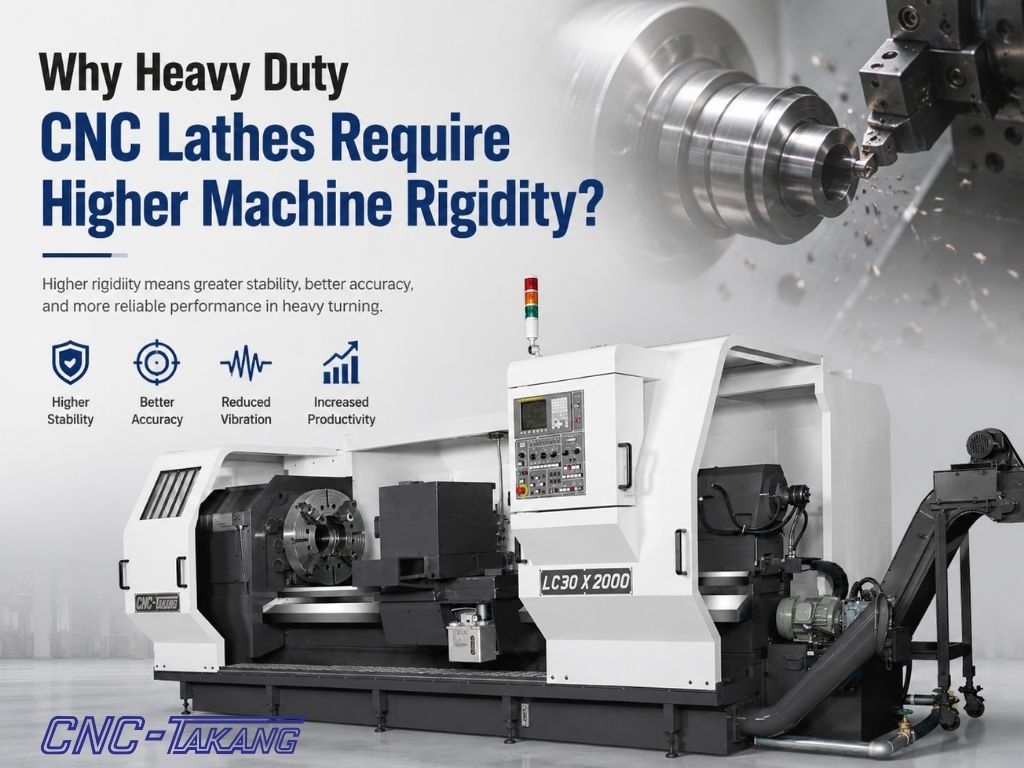
Why Heavy Duty CNC Lathes Require Higher Machine Rigidity?
Manufacturers machining large shafts, rollers, flanges, pipes, and other heavy workpieces often face a common challenge: maintaining accuracy under high cutting loads. While cutting tools and machining parameters certainly affect machining quality, the machine itself plays an even more critical role. Among all machine characteristics, rigidity is one of the most important factors influencing machining stability, dimensional accuracy, and long-term productivity.
A heavy duty CNC lathe is specifically designed to withstand the substantial cutting forces generated during large-part machining. Compared with standard CNC lathes, heavy-duty models feature stronger machine structures, more robust spindle systems, and higher load capacities that enable stable machining even under demanding operating conditions.
With decades of experience in manufacturing machine tools for large-part machining applications, CNC-TAKANG understands the challenges manufacturers face when processing oversized industrial components. This article explains why machine rigidity is essential and how heavy duty CNC lathes are engineered to deliver reliable performance.
What Does Machine Rigidity Mean?
Machine rigidity refers to a machine's ability to resist deformation when subjected to cutting forces. During turning operations, cutting pressure is continuously transmitted through the cutting tool, spindle, machine bed, guideways, and workpiece. If any part of this structure deflects excessively, machining accuracy may be compromised.
Higher rigidity helps maintain consistent tool positioning throughout the cutting process, allowing the machine to produce accurate dimensions and better surface finishes even during demanding cutting operations. For manufacturers producing large industrial components, rigidity may be more important than maximum spindle speed because stable cutting conditions directly influence accuracy, tool life, and production consistency.
Why Rigidity Matters in Heavy Duty CNC Lathes
Heavy duty CNC lathes are built to remove large amounts of material while maintaining dimensional accuracy. As workpiece size, diameter, and weight increase, the machine must withstand significantly higher cutting forces than those encountered in standard turning applications.
Without sufficient rigidity, excessive machine movement may result in:
- Poor dimensional accuracy
- Surface finish defects
- Increased vibration
- Tool chatter
- Reduced tool life
- Lower machining efficiency
A rigid machine structure allows cutting forces to be absorbed and distributed more effectively, creating stable machining conditions throughout both roughing and finishing operations.
Machine Bed Design Plays a Critical Role
One of the primary factors affecting rigidity is the machine bed. Heavy duty CNC lathes typically feature wider beds, reinforced structures, and heavier machine bases than standard CNC lathes. These structural characteristics increase resistance to bending and vibration while providing a stable foundation for supporting large workpieces.
A well-designed bed also helps distribute cutting forces across the machine structure instead of concentrating them in a limited area. This improves stability during deep cuts and helps the machine maintain more consistent accuracy across long turning lengths.
For long shafts, rollers, and oversized components, a flat-bed design can provide important structural and workpiece-support advantages. Manufacturers evaluating different bed configurations can learn more about the advantages of flat bed CNC lathes for heavy-duty turning.
Spindle Rigidity Supports Stable Cutting Performance
The spindle is another critical component influencing overall machine rigidity. Large workpieces often require higher cutting torque, larger chucks, and greater spindle support. If spindle deflection occurs during machining, the results may include inconsistent diameters, poor roundness, unstable tool engagement, and surface imperfections.
Heavy duty CNC lathes are generally equipped with robust spindle systems designed to support larger workpieces and demanding cutting conditions. Stable spindle performance helps maintain consistent tool engagement throughout the turning cycle, which contributes to improved machining accuracy and repeatability.
When evaluating spindle capability, manufacturers should consider more than motor power alone. Spindle construction, bearing support, torque characteristics, spindle bore, and compatibility with the required chuck size all affect the machine's actual performance under load.
Reduced Vibration Improves Surface Finish
Vibration is one of the most common causes of poor machining quality. When machine rigidity is insufficient, vibration can develop between the cutting tool and workpiece. This may leave chatter marks on the finished surface, reduce dimensional consistency, accelerate tool wear, and limit the cutting parameters that can be used safely.
Heavy duty CNC lathes help reduce vibration through:
- Rigid machine construction
- Substantial machine weight
- Stable spindle support
- Strong guideway systems
- Properly supported workpieces
- Optimized structural design
Reducing vibration enables smoother cutting action, longer tool life, and more consistent surface quality. Vibration is also one of several issues encountered in large-part turning. For a broader overview, read about the common challenges in heavy turning and how modern CNC lathes address them.
Guideway Strength Influences Machine Stability
Guideways support and control the movement of the carriage and cutting tool. During heavy turning, they must resist cutting loads while maintaining smooth and accurate axis movement. If the guideway system lacks sufficient load capacity or damping performance, tool position may become less stable under demanding cutting conditions.
Strong guideway systems help the machine maintain alignment while moving heavy carriage assemblies and cutting tools. Their contribution to vibration damping and load distribution is especially important during roughing operations involving larger depths of cut.
Manufacturers should therefore evaluate guideway construction together with bed width, machine weight, spindle design, and carriage size rather than considering each specification separately.
Workpiece Support Is Part of the Rigidity System
Machine rigidity alone cannot guarantee stable machining if the workpiece is not supported correctly. Long shafts and rollers may bend or vibrate under their own weight or under cutting pressure, even when the machine structure remains stable.
Tailstocks, steady rests, and follow rests help control workpiece deflection by providing additional support along the turning length. The appropriate support arrangement depends on workpiece diameter, length, weight distribution, material, and the location of the cutting operation.
For large or long parts, buyers should consider whether the machine can accommodate the necessary support equipment and whether the bed length provides enough space for both the workpiece and its supporting accessories.
Higher Rigidity Can Increase Productivity
Many manufacturers associate heavy duty CNC lathes mainly with larger workpiece capacity, but rigidity also has a direct effect on productivity. A stable machine can often operate with more demanding cutting conditions while controlling vibration and tool movement.
Depending on the workpiece, tooling, and material, higher rigidity may support:
- Higher feed rates
- Larger depths of cut
- Greater material removal rates
- More consistent tool engagement
- Reduced need for repeated finishing passes
- More stable extended machining cycles
This can shorten cycle times while maintaining machining quality. However, the appropriate cutting parameters must still be determined according to the material, tool geometry, workpiece setup, and spindle capability.
How Machine Rigidity Affects Machining Results
| Machining Requirement | How Higher Rigidity Helps |
|---|---|
| Dimensional Accuracy | Reduces structural deflection and supports more consistent tool positioning. |
| Surface Finish | Helps suppress vibration and chatter during cutting. |
| Tool Life | Maintains more stable tool engagement and reduces irregular cutting loads. |
| Material Removal | Supports demanding roughing operations with greater cutting stability. |
| Long-Part Turning | Provides a stable machine foundation when combined with suitable workpiece support. |
| Production Consistency | Helps maintain repeatable cutting conditions across extended machining cycles. |
Applications That Benefit from Heavy Duty CNC Lathes
Industries that frequently process large, long, or heavy components benefit significantly from high-rigidity CNC lathes. These applications often involve demanding materials, substantial cutting loads, or extended machining cycles that require stable machine performance.
Typical applications include:
- Oil and gas equipment
- Energy industry components
- Steel mill components
- Shipbuilding equipment
- Mining machinery
- Heavy construction equipment
- Large industrial rollers
- Hydraulic cylinder components
- Long shafts and spindles
- Large flanges and pipe-related components
The correct machine configuration depends on the workpiece dimensions, material, required accuracy, production volume, and turning operations involved. Rigidity is essential, but it must be considered together with swing capacity, turning length, spindle torque, spindle bore, workpiece weight, and support requirements.
Heavy Duty CNC Lathe Solutions from CNC-TAKANG
CNC-TAKANG manufactures a comprehensive range of heavy duty CNC lathes designed for stable machining of large and heavy workpieces. The product lineup includes multiple specifications and configurations to accommodate different workpiece diameters, turning lengths, and industrial production requirements.
With rigid machine structures, robust spindle systems, and heavy-duty bed designs, these machines are developed to withstand demanding cutting conditions while maintaining consistent machining performance. They are suited to large-part turning applications involving shafts, rollers, flanges, pipes, and other industrial components.
Manufacturers can explore CNC-TAKANG’s heavy duty flat bed CNC lathe series to compare available machine capacities and identify suitable configurations for their machining requirements.
Frequently Asked Questions (FAQ)
Q1: What makes a CNC lathe heavy duty?
A heavy duty CNC lathe is designed with a reinforced machine structure, robust spindle support, wider bed construction, higher load capacity, and suitable workpiece-support systems for machining large or heavy components under demanding cutting conditions.
Q2: Why is machine rigidity important?
Higher rigidity helps minimize structural deflection and vibration. This supports better dimensional accuracy, more consistent surface finishes, stable tool engagement, and reliable machining performance.
Q3: Does a heavier machine always provide better rigidity?
Not necessarily. Machine weight can contribute to stability, but structural design, material distribution, bed geometry, guideway construction, spindle support, and overall engineering are also important.
Q4: Can rigidity eliminate all turning vibration?
No. Machine rigidity is a major factor, but vibration may also result from improper workpiece support, unsuitable cutting parameters, tool overhang, workpiece imbalance, tooling selection, or spindle condition.
Q5: Which industries commonly use heavy duty CNC lathes?
Heavy duty CNC lathes are commonly used in shipbuilding, energy equipment, oil and gas, steel processing, heavy machinery, mining, and industrial component manufacturing.
Q6: How does machine rigidity improve productivity?
A rigid machine can maintain more stable cutting conditions under demanding loads. Depending on the application, this may allow higher material removal rates, fewer corrective passes, more consistent tool life, and shorter production cycles.
Conclusion
Machine rigidity is one of the defining characteristics that separates a heavy duty CNC lathe from a standard CNC turning machine. From controlling vibration and spindle deflection to supporting higher cutting loads and maintaining dimensional accuracy, a rigid machine structure plays a fundamental role in successful large-part machining.
For manufacturers processing oversized shafts, heavy industrial components, and demanding workpieces, selecting a CNC lathe with suitable structural rigidity can improve machining quality, productivity, and long-term operational stability.
Contact CNC-TAKANG today to discuss your workpiece dimensions, materials, and production requirements and identify a suitable heavy duty CNC lathe configuration for your application.
Related Articles