Blog
Common Causes of Bore Misalignment and How Boring Milling Machines Help Prevent It
In large-component manufacturing, bore accuracy is often one of the most critical factors affecting final product quality. Whether producing gearbox housings, pump bodies, valve blocks, machine frames, or heavy equipment components, even a small amount of bore misalignment can create significant assembly issues, reduce operational performance, and increase production costs.
As manufacturers continue to demand tighter tolerances and greater machining efficiency, maintaining precise bore alignment has become increasingly challenging. Understanding the common causes of bore misalignment—and selecting the right machining solution—can help manufacturers improve quality, reduce rework, and enhance productivity.
With decades of experience in manufacturing machine tools for large-part machining applications, CNC-TAKANG has developed a deep understanding of the challenges manufacturers face when machining complex components. In this article, we'll explore the most common causes of bore misalignment and explain how boring milling machines help manufacturers achieve greater machining accuracy.
What Is Bore Misalignment?
Bore misalignment occurs when two or more machined bores are not positioned correctly relative to their intended centerline, resulting in errors in concentricity, parallelism, or positional accuracy. These alignment issues may appear small during machining, but they can create major problems during assembly and operation.
In industries such as energy equipment, heavy machinery, mold manufacturing, and industrial automation, bore alignment directly affects how shafts, bearings, gears, and other mating components fit together. Poor alignment can lead to excessive vibration, uneven load distribution, premature component wear, and reduced equipment lifespan. As workpiece size increases, maintaining accurate bore positioning becomes even more challenging due to machine deflection, thermal variation, and workpiece stability.
Why Bore Alignment Is Critical in Large-Part Manufacturing
Large industrial components often contain multiple bores that must maintain precise geometric relationships. Examples include gearbox housings, pump casings, valve bodies, machine bases, and transmission components. If these bores are not aligned correctly, assembly operations become more difficult and overall product quality can suffer.
Unlike smaller parts, large workpieces are more susceptible to distortion, vibration, and positioning errors during machining. Even minor deviations can affect bearing alignment, shaft rotation, and equipment performance. For manufacturers producing high-value components, maintaining bore accuracy is not simply a quality requirement—it is essential for ensuring long-term reliability and customer satisfaction.
Multiple Setups Often Create Bore Alignment Problems
One of the most common causes of bore misalignment is repeated workpiece repositioning during machining. Large housings, machine frames, and structural components often require machining on multiple surfaces. When a workpiece must be removed and re-clamped several times, small positioning errors can accumulate throughout the manufacturing process.
Even with accurate fixtures and experienced operators, each additional setup introduces the possibility of deviation between machining operations. These accumulated errors can affect the relationship between bores located on different faces of the workpiece, making it difficult to maintain concentricity and positional accuracy.
How Boring Milling Machines Help
Boring milling machines allow multiple machining operations to be completed in a single setup whenever possible. By reducing repositioning requirements, manufacturers can maintain more consistent relationships between machined features and significantly improve bore alignment accuracy.
Machine Rigidity Directly Affects Bore Accuracy
Machine rigidity plays a critical role in maintaining stable cutting conditions. During boring operations, cutting forces are continuously applied to both the tool and the workpiece. If the machine structure lacks sufficient rigidity, vibration and deflection can occur, negatively affecting bore quality.
Common symptoms include poor roundness, inconsistent bore diameters, surface finish defects, and positional inaccuracies. As workpiece size and material hardness increase, the importance of machine rigidity becomes even more significant.
How Boring Milling Machines Help
Boring milling machines are typically designed with robust columns, heavy-duty structures, and rigid spindle systems. This construction helps minimize vibration and maintain stable cutting conditions, resulting in greater bore accuracy and repeatability.
Tool Deflection Becomes More Severe in Deep Bore Machining
Deep-hole and long-reach boring operations present unique challenges. As boring bars extend farther from the spindle, they become more susceptible to bending and vibration. Even slight tool deflection can affect bore straightness, diameter consistency, and concentricity.
This issue is especially common when machining large housings, thick-walled castings, and industrial components requiring deep internal features. The longer the tool extension, the more difficult it becomes to maintain dimensional accuracy.
How Boring Milling Machines Help
Modern boring milling machines are engineered to support long-reach tooling while maintaining cutting stability. Their rigid structures and spindle systems help reduce tool movement during machining, allowing manufacturers to achieve better accuracy in deep-bore applications.
Thermal Expansion Can Influence Bore Positioning
Heat generation is unavoidable during machining. As machine structures, cutting tools, and workpieces absorb heat, thermal expansion can occur. In large-part machining, even small amounts of thermal movement can influence bore location and dimensional accuracy.
Extended machining cycles and heavy cutting operations can amplify these effects, particularly when multiple bores must maintain strict positional relationships. Without proper machine stability, thermal variation can gradually introduce alignment errors.
How Boring Milling Machines Help
Boring milling machines are designed with stable structures and precision-engineered components that help minimize the influence of thermal variation. Their robust construction contributes to more consistent performance during long machining cycles and demanding production environments.
Large Workpieces Create Additional Alignment Challenges
Large and heavy components introduce machining challenges that smaller parts rarely encounter. Workpiece sagging, uneven support conditions, clamping distortion, and material stress can all affect bore positioning during machining.
These factors become increasingly important when machining large machine frames, energy equipment components, and heavy industrial structures. As workpiece dimensions grow, maintaining alignment accuracy requires both proper machine capability and stable workpiece support.
How Boring Milling Machines Help
Boring milling machines are specifically designed for large-component machining. Their spacious worktables, high load capacities, and rigid machine structures help support oversized workpieces while maintaining stable machining conditions throughout the operation.
Why Boring Milling Machines Are Designed to Minimize Misalignment
Boring milling machines remain one of the most effective solutions for applications where bore accuracy is critical. Unlike general-purpose machining centers, they are specifically engineered to handle large workpieces, deep bores, and complex internal machining operations.
Their advantages include:
| Requirement | Boring Milling Machine Advantage |
|---|---|
| Bore Alignment | Excellent positional accuracy |
| Large Components | Designed for oversized workpieces |
| Deep-Hole Machining | Better support for long-reach tooling |
| Multi-Side Machining | Reduced setup requirements |
| Structural Rigidity | Stable heavy-duty machining performance |
By combining rigidity, stability, and machining flexibility, boring milling machines help manufacturers reduce alignment-related issues and improve overall machining quality.
Boring Milling Machine Solutions from CNC-TAKANG
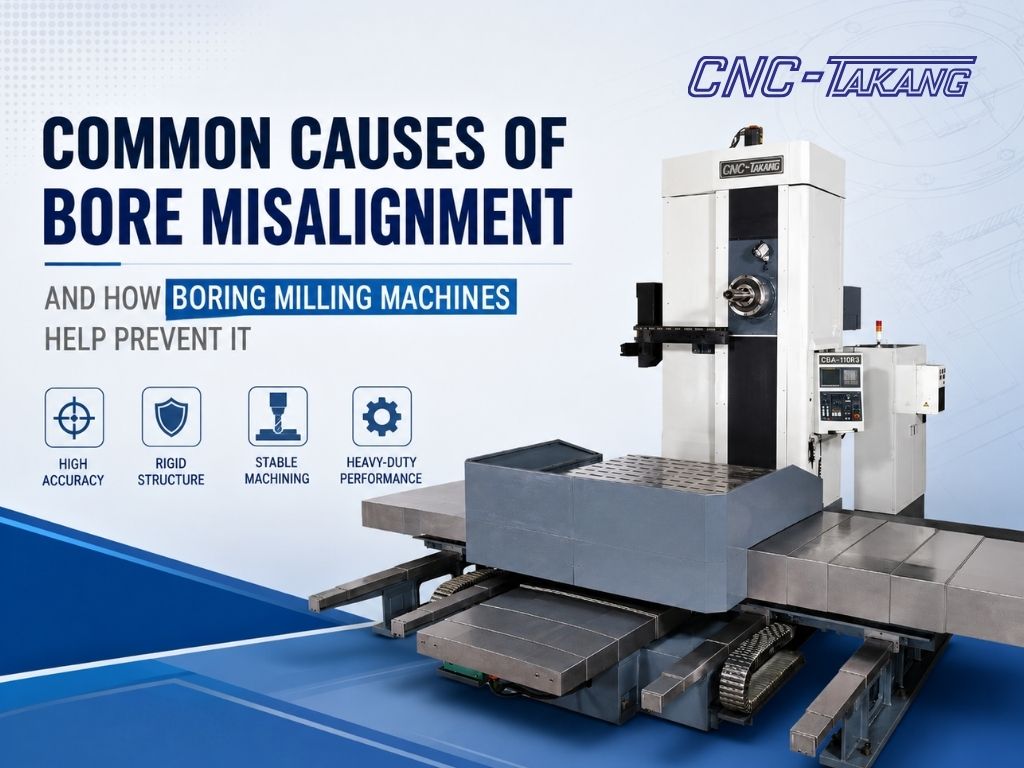
CNC-TAKANG offers a range of boring milling machines designed for precision horizontal machining applications involving large and complex workpieces. Built with rigid machine structures, stable spindle systems, and large-capacity worktables, these machines support accurate boring, milling, drilling, and multi-side machining operations.
Designed for industries such as mold manufacturing, energy equipment, and heavy machinery production, CNC-TAKANG boring milling machines help manufacturers improve bore accuracy, reduce setup-related errors, and maintain consistent machining performance in demanding production environments.
Frequently Asked Questions (FAQ)
Q1: What is bore misalignment?
Bore misalignment occurs when machined bores are not positioned correctly relative to each other, resulting in errors in concentricity, parallelism, or positional accuracy.
Q2: Why is bore alignment important?
Proper bore alignment ensures accurate assembly of shafts, bearings, gears, and other mating components, helping improve equipment reliability and operational performance.
Q3: What causes bore misalignment during machining?
Common causes include multiple setups, insufficient machine rigidity, tool deflection, thermal expansion, and workpiece distortion.
Q4: Why are boring milling machines preferred for large housing components?
They provide the rigidity, stability, and machining capacity required to maintain accurate bore alignment in large and complex workpieces.
Q5: Can machine rigidity affect bore quality?
Yes. Higher machine rigidity helps reduce vibration and deflection, improving bore accuracy, surface finish quality, and machining consistency.
Conclusion
Bore misalignment remains one of the most common challenges in large-part machining. Factors such as repeated setups, machine rigidity limitations, tool deflection, thermal variation, and workpiece size can all contribute to alignment issues that affect final product quality and assembly performance.
By understanding these challenges and investing in equipment specifically designed to address them, manufacturers can significantly improve machining accuracy and production efficiency. For applications involving large housings, machine frames, energy equipment, and other precision industrial components, boring milling machines continue to provide a reliable solution for achieving accurate and consistent bore alignment.
Contact CNC-TAKANG today to learn more about boring milling machine solutions designed for precision horizontal machining and large-component manufacturing applications.