Blog
Selecting a Conventional Lathe for Your Workshop: Key Factors to Consider
Despite the rapid growth of CNC automation in modern manufacturing, the conventional lathe continues to play an important role in workshops around the world. From repair work and maintenance tasks to low-volume production and general machining, manual turning machines remain highly valued for their flexibility, simplicity, and cost efficiency.
For many workshops, selecting the right conventional lathe is not simply about choosing the biggest machine available. Factors such as workpiece size, spindle capacity, rigidity, and intended applications all influence long-term usability and productivity. Choosing the wrong machine can lead to unnecessary limitations, reduced efficiency, or higher operating costs.
With extensive experience in machine tool solutions, CNC-TAKANG works closely with manufacturers and workshop operators to help identify suitable conventional lathe configurations based on real machining requirements. In this guide, we’ll explore the key factors manufacturers should evaluate before selecting a conventional lathe for their workshop.
Understand Your Typical Workpiece Size
One of the first considerations when selecting a conventional lathe is the size of the workpieces you plan to machine.
Important specifications include:
-
Swing over bed
-
Swing over cross slide
-
Distance between centers
-
Maximum workpiece weight
For example, workshops producing long shafts or rollers may require extended distance between centers, while general repair applications may prioritize flexibility over maximum turning length.
Choosing a lathe with insufficient capacity can restrict future machining possibilities, while oversizing the machine may increase unnecessary investment and floor space requirements.
Evaluate Spindle Bore and Workpiece Requirements
Spindle bore size directly affects the types of materials and workpieces the machine can handle.
A larger spindle bore allows operators to feed larger-diameter bars or pipes through the spindle, which is particularly useful for:
-
Shaft machining
-
Pipe processing
-
Long cylindrical components
-
Repair and maintenance applications
Workshops handling diverse materials often benefit from machines with more flexible spindle configurations.
Machine Rigidity and Bed Structure Matter
The rigidity of a conventional lathe significantly influences machining stability, cutting performance, and surface finish quality.
Heavy-duty cutting operations generate substantial cutting forces, and machines with weak structures may experience vibration or reduced accuracy over time.
Key structural features to evaluate include:
-
Bed width
-
Bed casting quality
-
Guideway design
-
Overall machine weight
A rigid flat-bed structure generally provides better stability for medium-to-heavy turning applications and improves long-term durability.
Consider the Types of Turning Operations
Different workshops prioritize different machining tasks. Before selecting a machine, manufacturers should evaluate the most common operations performed in their facility.
Typical conventional lathe applications include:
-
General turning
-
Facing
-
Thread cutting
-
Taper turning
-
Shaft repair
-
Flange machining
-
General workshop machining
Understanding your operational priorities helps determine the most suitable machine configuration and optional accessories.
Workshop Space and Operator Experience
Practical considerations are also important when selecting a conventional lathe.
Larger machines require:
-
More installation space
-
Stronger foundations
-
Higher power requirements
Operator experience also plays a role. Some workshops prioritize simpler manual controls and ease of operation, especially in environments where flexibility and direct machine control are important.
Selecting a machine that matches both the workspace and operator skill level helps improve overall efficiency.
Conventional Lathe Solutions from CNC-TAKANG
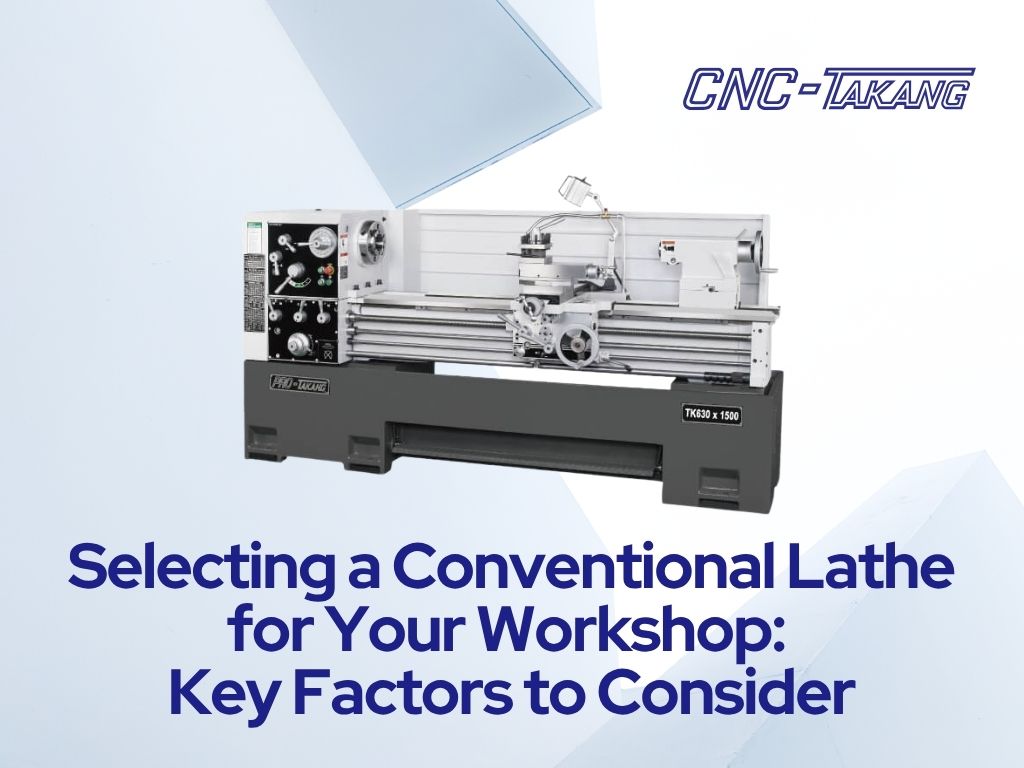
CNC-TAKANG offers a diverse range of conventional lathes designed for stable and reliable manual turning applications. Key product series include the TK450/540/630 and TK600/670/770/840 models, providing various swing capacities and machining configurations to accommodate different workpiece sizes and machining requirements.
Built upon years of machine tool manufacturing experience, CNC-TAKANG conventional lathes feature a multi-gear spindle design that delivers flexible speed selection and dependable cutting performance for general-purpose and medium-to-heavy turning applications. Combined with rigid machine structures and durable bed construction, these machines are suitable for machining shafts, flanges, rollers, and various industrial components.
Frequently Asked Questions (FAQ)
Q1: What is the advantage of a conventional lathe compared to a CNC lathe?
A conventional lathe offers greater flexibility for repair work, low-volume production, and quick manual adjustments without programming requirements.
Q2: Are conventional lathes still widely used today?
Yes. Conventional lathes remain common in maintenance workshops, repair applications, and general machining environments.
Q3: How do I determine the correct lathe size?
The appropriate size depends on workpiece diameter, length, weight, and the types of turning operations performed most frequently.
Q4: Why is spindle bore size important?
A larger spindle bore allows larger bars or pipes to pass through the spindle, increasing machining flexibility for long cylindrical workpieces.
Q5: What industries commonly use conventional lathes?
Conventional lathes are widely used in repair, maintenance, metalworking, toolmaking, and general industrial machining applications.
Conclusion
Selecting the right conventional lathe requires more than simply comparing machine sizes or specifications. Workpiece dimensions, spindle capacity, machine rigidity, workshop space, and operational requirements all play important roles in determining the most suitable solution.
For workshops seeking stable and reliable manual turning performance, choosing a machine that matches both current and future production needs can significantly improve long-term efficiency and flexibility.
Contact CNC-TAKANG today to explore conventional lathe solutions designed for general machining, repair work, and industrial turning applications.