Blog
When Should You Use a Swiss Turn CNC Lathe? A Practical Buyer’s Guide
In modern precision manufacturing, small parts are becoming more complex, more compact, and more tolerance-critical than ever before. Industries such as medical devices, electronics, aerospace, and automotive sensors all require high-accuracy machining of slender and miniature components. In these scenarios, choosing the right machine platform is not just a technical decision — it directly affects yield, cycle time, and production cost.
As a supplier of advanced turning solutions, CNC-TAKANG works with manufacturers who often ask the same question: When is a Swiss Turn CNC lathe truly necessary, and when is a standard CNC lathe enough? This practical guide breaks down the real-world decision factors so buyers and engineers can choose the right technology with confidence.
What Makes a Swiss Turn CNC Lathe Different?
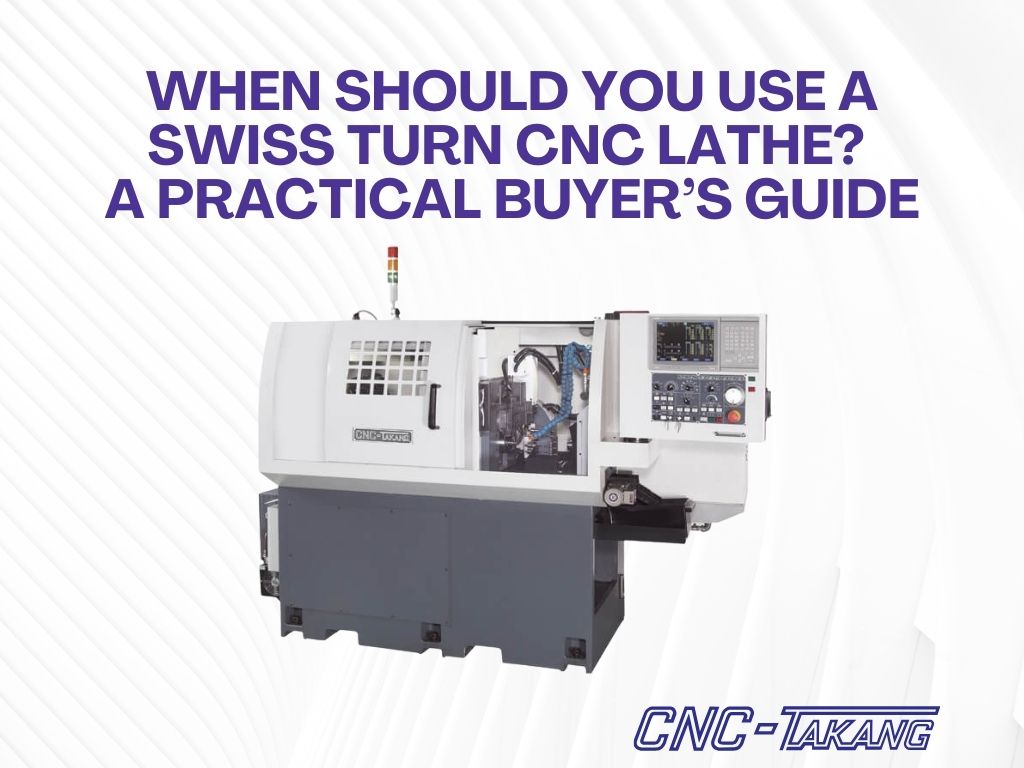
A Swiss Turn CNC lathe — also known as a Swiss-type or sliding headstock lathe — is designed specifically for machining long, slender, small-diameter parts with exceptional precision. Unlike conventional CNC lathes where the workpiece is clamped and rotated from a fixed spindle position, a Swiss machine uses a sliding headstock and guide bushing system.
The bar stock is supported very close to the cutting point by the guide bushing, dramatically reducing deflection and vibration. This structural difference is the key reason Swiss machines can achieve tighter tolerances on long, thin components.
Use a Swiss Turn CNC Lathe When Parts Are Long and Slender
One of the clearest indicators that you should use a Swiss Turn CNC lathe is the length-to-diameter ratio of your part.
If you are machining:
-
Long pins
-
Micro shafts
-
Connector terminals
-
Bone screws
-
Sensor stems
-
Thin rods with tight runout requirements
A conventional CNC lathe may struggle with vibration and bending. A Swiss machine keeps the cutting zone supported, allowing stable cutting even when diameters are very small.
A common rule of thumb in the industry is:
If the part length exceeds about 20–25× the diameter, Swiss-type turning should be strongly considered.
Choose Swiss Turning for Ultra-Tight Tolerances
Swiss Turn CNC lathes are widely used when tolerance control is critical. Because the workpiece is supported right at the cutting point, tool pressure causes far less material deflection. This leads to:
-
Better concentricity
-
Improved roundness
-
More consistent diameters
-
Reduced taper on long cuts
This is especially important in medical, aerospace, and precision electronics parts where even minor deviation can lead to assembly or performance issues.
Swiss Machines Excel in High-Volume Small Parts Production
Swiss Turn CNC lathes are not only about precision — they are also about efficient production of small parts. Many Swiss machines are configured with:
-
Multiple tool stations
-
Back working capability
-
Sub-spindles
-
Live tooling
-
Bar feeders
This allows multiple operations to be completed in one cycle without secondary handling. For high-volume small components, this dramatically reduces total cycle time and labor cost.
If your production involves thousands or millions of identical small parts, Swiss turning is often the most economical long-term solution.
When a Standard CNC Lathe May Be the Better Choice
Despite their advantages, Swiss Turn CNC lathes are not always the right answer. A standard CNC lathe is often more suitable when:
-
Part diameters are large
-
Parts are short and rigid
-
Setup flexibility is more important than cycle time
-
Batch sizes are small and varied
-
Programming simplicity is preferred
Swiss machines typically involve more complex setup, guide bushing configuration, and tooling layout. For general turning work, they may be unnecessarily specialized.
Practical Buying Factors to Evaluate
When deciding whether to invest in a Swiss Turn CNC lathe, buyers should evaluate:
Part geometry — Are parts slender and small in diameter?
Tolerance requirements — Are tolerances beyond standard turning capability?
Production volume — Is output high enough to justify Swiss setup?
Material type — Are materials prone to deflection?
Secondary operations — Can Swiss reduce downstream processes?
Automation plans — Will bar feeding and unattended running be used?
Answering these questions helps clarify whether Swiss turning is a technical need or just a perceived upgrade.
Swiss Turn CNC Lathe Solutions from CNC-TAKANG
CNC-TAKANG offers Swiss Turn CNC lathe solutions designed for high-precision small-part machining across medical, electronics, automotive, and precision mechanical industries. These machines are engineered for stable bar feeding, precise guide bushing support, and multi-operation machining within a compact footprint.
By working closely with customers to understand part geometry, tolerance targets, and production goals, CNC-TAKANG helps manufacturers select the most suitable Swiss turning configuration — avoiding both under-spec and over-spec machine investments.
Frequently Asked Questions (FAQ)
Q1: Is a Swiss Turn CNC lathe only for very small parts?
Mostly yes, but not exclusively. They are optimized for small-diameter, long, slender components where support near the cutting point is critical.
Q2: Are Swiss machines more expensive than standard CNC lathes?
Typically yes, but they often reduce total production cost for high-precision small parts through faster cycle times and fewer secondary operations.
Q3: Do Swiss lathes always require a bar feeder?
In most production environments, yes. Swiss machines are commonly paired with bar feeders for continuous operation.
Q4: Is programming more complex on Swiss machines?
Programming and setup can be more complex due to multiple tool positions and synchronized operations.
Q5: Can Swiss machines perform milling and cross drilling?
Yes. Many Swiss Turn CNC lathes include live tooling for milling, drilling, and cross-hole operations.
Conclusion & CTA
A Swiss Turn CNC lathe is not just a precision upgrade — it is a specialized solution for a specific class of parts. When components are small, slender, tolerance-critical, and produced in volume, Swiss turning delivers measurable advantages in accuracy, stability, and efficiency.
If you are evaluating whether Swiss-type turning is right for your application, the CNC-TAKANG team can help review your part drawings, tolerance requirements, and production goals to recommend the most suitable machine solution.
Contact CNC-TAKANG today to discuss your Swiss turning requirements and explore the right configuration for your production needs.