Blog
Double Column vs. Gantry-Type Machining Centers: What’s the Difference?
As workpieces in modern manufacturing grow larger, heavier, and more complex, standard machining centers often reach their structural and travel limits. To handle oversized parts while maintaining machining accuracy, manufacturers increasingly turn to Double Column Machining Centers and Gantry-Type Machining Centers.
Although these two machine categories are sometimes discussed interchangeably, they differ in structure, motion design, and ideal applications. Understanding these differences is essential when selecting the right equipment for large-part machining.
With years of experience supplying heavy-duty machining solutions, CNC-TAKANG regularly works with manufacturers evaluating large-format machining centers for production expansion. This article explains the key distinctions between double column and gantry-type machining centers, helping buyers make informed investment decisions.
What Is a Double Column Machining Center?
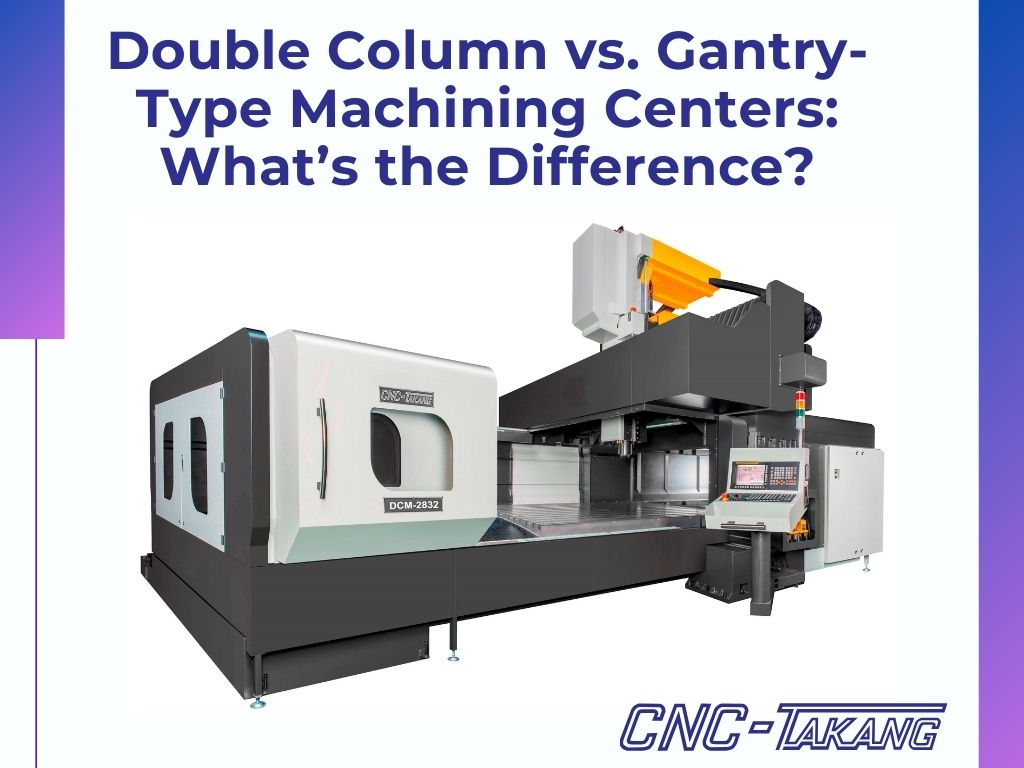
A Double Column Machining Center features two fixed vertical columns supporting a rigid crossbeam, while the worktable moves along the base to position the workpiece under the spindle. The spindle head travels vertically and horizontally across the crossbeam to perform cutting operations.
This structure provides high rigidity, excellent stability during heavy cutting, and consistent accuracy across long machining strokes. Double column machines are particularly effective for machining large plates, mold bases, structural frames, and heavy mechanical housings where workpiece weight is significant but dynamic table movement remains manageable.
What Is a Gantry-Type Machining Center?
A Gantry-Type Machining Center uses a moving bridge (gantry) that travels over a stationary worktable. Instead of moving the workpiece, the entire gantry structure moves along the machine bed, while the spindle head travels across the gantry beam.
This design offers a stationary worktable for extremely heavy parts, large and expandable work envelopes, and flexibility for multi-axis and multi-head configurations. Gantry machines are widely used when workpieces are too heavy or too large to move efficiently.
Key Structural Differences
| Feature | Double Column Machining Center | Gantry-Type Machining Center |
|---|---|---|
| Workpiece Movement | Moving table | Fixed table |
| Structural Design | Fixed dual columns with moving table | Moving gantry bridge over fixed table |
| Rigidity | Very high | Extremely high |
| Suitable Workpiece Size | Large | Very large / ultra-large |
| Load Capacity | High | Very high |
| Floor Space Requirement | Moderate | Large |
| Typical Industries | Mold, heavy machinery, tooling | Shipbuilding, energy, aerospace |
| Investment Cost | Mid to high | High to very high |
Which One Should You Choose?
Choose a Double Column Machining Center if:
Your workpieces are large but still movable by table drive systems, you need strong rigidity with efficient footprint usage, and you focus on mold bases, machine frames, and heavy mechanical parts.
Choose a Gantry-Type Machining Center if:
Your workpieces are extremely heavy or oversized, moving the workpiece during machining is impractical, and you need extended axis travel for very large components.
CNC-TAKANG Large-Format Machining Center Solutions
CNC-TAKANG offers a comprehensive range of double column machining centers designed for stable, high-precision machining of large and heavy workpieces. These machines emphasize rigid column and crossbeam structures for vibration suppression, long-axis travel to accommodate large mold bases and plates, and high-torque spindle systems for heavy material removal.
By focusing on structural stability and flexible configuration, CNC-TAKANG’s machining centers serve industries such as mold manufacturing, heavy machinery, energy equipment, and large-part fabrication where machining consistency is critical.
Frequently Asked Questions (FAQ)
Q1: Are double column and gantry-type machines both considered heavy-duty machining centers?
Yes. Both are classified as heavy-duty machining centers, but gantry-type machines typically handle larger and heavier workpieces.
Q2: Which design offers better accuracy for large mold machining?
Double column machining centers are commonly preferred for large mold bases due to their high rigidity and stable table movement.
Q3: Do gantry-type machines always require special foundations?
Often yes. Because of their size and moving bridge structure, gantry machines typically require reinforced foundations.
Q4: Can double column machines support multi-axis machining?
Yes. Many double column machining centers can be equipped with rotary tables, indexing heads, or multi-axis spindle attachments.
Q5: Is gantry-type machining always more expensive?
Generally yes, due to larger structures, higher load capacity, and extended travel systems.
Conclusion
Both double column and gantry-type machining centers play vital roles in large-part manufacturing. While double column designs offer an efficient and rigid solution for large molds and heavy mechanical components, gantry-type machines excel when workpieces become too massive to move.
As industrial requirements continue to evolve, choosing the right machining center becomes critical to long-term productivity and machining stability. CNC-TAKANG works closely with manufacturers to evaluate application requirements and recommend suitable machining solutions.
Discuss your large-part machining challenges with our team and explore the right machining center solution for your operation.