Blog
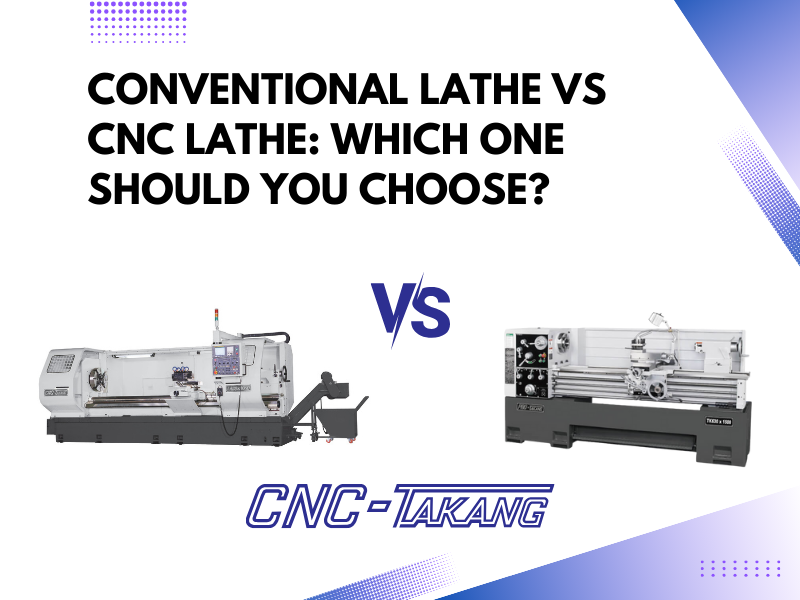
Conventional Lathe vs CNC Lathe: Which One Should You Choose?
When it comes to turning operations in manufacturing, two major types of lathes dominate the scene: the conventional (manual) lathe and the CNC (Computer Numerical Control) lathe. Each has its own strengths, limitations, and ideal use cases. Whether you’re a workshop owner, production manager, or a machining enthusiast, choosing the right lathe can greatly influence productivity, precision, and cost-efficiency. In this article, we’ll break down the differences between conventional and CNC lathes to help you make an informed decision.
What Is a Conventional Lathe?
A conventional lathe, also known as a manual lathe, is operated manually by an experienced machinist. The operator uses handwheels and levers to control the spindle speed, feed rate, and tool movement. This type of lathe is best suited for simple machining tasks or low-volume production where flexibility is needed.
Advantages of Conventional Lathes
- Cost-Effective Initial Investment: Manual lathes are generally less expensive to purchase and maintain compared to CNC machines.
- Great for Short Runs: For custom or prototype parts, a manual lathe provides the flexibility to make quick adjustments without lengthy programming.
- Hands-On Skill Development: Operators gain a deep understanding of machining principles and craftsmanship.
Limitations
- Operator Dependent: The quality of the output depends heavily on the skill and experience of the operator.
- Lower Precision on Complex Parts: Complex geometries and repeatable accuracy are difficult to achieve.
- Time-Consuming: Manual setups and machining processes are slower, especially for high-volume production.
What Is a CNC Lathe?
A CNC lathe is a computer-controlled machine that automates the cutting process. Operators input commands through G-code programming, and the machine executes precise tool movements without manual intervention. This makes CNC lathes ideal for high-volume production and complex part geometries.
Advantages of CNC Lathes
- High Precision and Repeatability: CNC machines can produce identical parts consistently with minimal tolerance variation.
- Efficient for Large Batches: Once a program is created, it can be reused, saving time for high-volume or repeat orders.
- Automation and Multi-Axis Capability: Many CNC lathes come with additional features such as live tooling, bar feeders, and sub-spindles to improve production speed and complexity.
Limitations
- High Initial Investment: CNC machines are significantly more expensive than conventional lathes, both in terms of equipment and operator training.
- Programming Required: Operators must understand G-code or CAM software to create part programs.
- Less Flexibility for Small Batches: Setting up a CNC lathe for one-off jobs may not be time-efficient due to programming and setup requirements.
Key Comparison Table
| Feature | Conventional Lathe | CNC Lathe |
|---|---|---|
| Operation | Manual | Computer-controlled |
| Initial Cost | Lower | Higher |
| Precision | Operator-dependent | Highly repeatable and precise |
| Ideal Use Case | Prototypes, small batches | Mass production, complex parts |
| Skill Requirement | Manual machining expertise | Programming and CNC knowledge |
| Setup Time | Short for simple jobs | Longer initial setup |
| Flexibility | High for custom work | Low for one-off projects |
| Automation | None | Full automation possible |
Which Lathe Should You Choose?
The choice between a conventional lathe and a CNC lathe depends on your production needs, budget, and workforce skills.
Choose a Conventional Lathe if:
- You are producing small quantities or one-off parts.
- Your budget is limited.
- You value hands-on machining and versatility.
- You are in an educational or prototyping environment.
Choose a CNC Lathe if:
- You need high precision and consistency.
- You’re producing parts in medium to large volumes.
- You’re working with complex geometries or tight tolerances.
- You’re looking to scale up production with automation.
CNC-TAKANG Solutions from a Trusted Supplier
As an experienced machine tool supplier, we work closely with CNC-TAKANG, one of Taiwan’s leading manufacturers of CNC and conventional lathes, machining centers, and heavy-duty turning solutions. With more than 50 years of expertise in lathe development, CNC-TAKANG has built a global reputation for durability, precision, and innovation.
By partnering with CNC-TAKANG, we provide customers access to a wide range of machines—from versatile conventional lathes for training and maintenance, to advanced CNC lathes designed for high-volume production and complex geometries. Beyond supplying equipment, we help our clients evaluate their machining needs, recommend suitable models, and support long-term growth with reliable after-sales service.
Conclusion
Both conventional and CNC lathes have a place in modern machining. While conventional lathes offer flexibility and low upfront costs, CNC lathes provide the automation and precision needed for large-scale and intricate manufacturing tasks. Assessing your shop’s goals, capabilities, and volume will help you select the lathe that best fits your needs.
Looking for a trusted partner? With CNC-TAKANG’s proven range of machines and our expertise as a supplier, we ensure you get the reliability, performance, and value your operation deserves.