Blog
What Is a Double Column Machining Center? A Complete Guide for Industrial Buyers
As manufacturing demands evolve, the need for larger, more precise, and more stable machining solutions has grown significantly. For industries that work with oversized molds, dies, machine components, or aerospace structures, the double column machining center has become an essential part of modern production lines.
In this article, we’ll explore what a double column machining center is, how it works, and why it remains the preferred solution for heavy-duty and high-precision machining applications.
What Is a Double Column Machining Center?
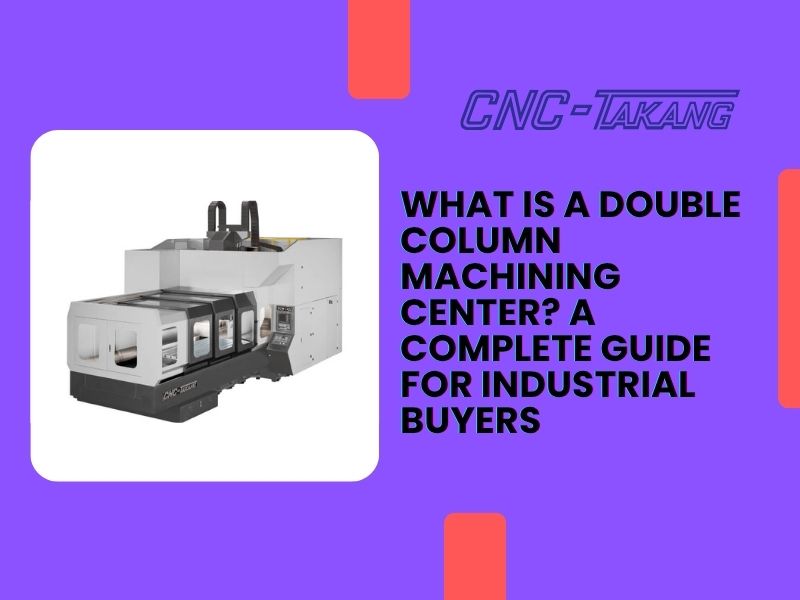
A double column machining center, also known as a bridge-type or gantry-type vertical machining center, is a high-rigidity CNC machine designed for the milling of large and heavy workpieces. Its defining feature is the use of two vertical columns (one on each side of the table), connected by a crossbeam or gantry. The spindle head moves along this crossbeam, while the worktable supports large and heavy parts.
This structure provides excellent rigidity and minimizes deflection during heavy cutting operations—making it especially suitable for industries requiring precision at a large scale.
Key Structural Components
Understanding the structure of a double column machining center helps highlight its capabilities:
-
Twin Vertical Columns: Provide high stability and support for the crossbeam, minimizing vibration and structural distortion.
-
Crossbeam (Bridge): Supports the moving spindle carriage, ensuring even weight distribution across the cutting zone.
-
Moving Spindle Head (Z-axis): Travels vertically and horizontally to reach all areas of the part.
-
Large Table (X-axis): Provides a broad work surface capable of supporting massive workpieces, often exceeding several tons.
-
Base/Foundation: Must be reinforced to support the size and weight of both the machine and the parts being machined.
How It Differs from Traditional Vertical Machining Centers
While conventional vertical machining centers (VMCs) are ideal for medium-sized components, their C-type column structure limits rigidity and work size. A double column machining center, on the other hand, is purpose-built for larger components and tougher cutting conditions.
| Feature | Conventional VMC | Double Column Machining Center |
|---|---|---|
| Structure | Single upright column (C-type) | Twin-column bridge (Gantry-type) |
| Workpiece Size | Medium | Large to extra-large |
| Rigidity | Moderate | High |
| Accuracy Over Distance | Lower (can drift) | Maintained |
| Typical Use | General parts machining | Mold, die, aerospace, energy parts |
Industries That Rely on Double Column Machining
-
Aerospace: For producing structural components like frames, wings, and mounting systems where both size and precision are critical.
-
Automotive: Used in the manufacture of molds, dies, and fixtures for body panels and powertrain components.
-
Energy: Ideal for machining parts in wind power, oil & gas, and large valves or flanges for pipelines.
-
Heavy Equipment: Used for producing structural bases, engine housings, and gearboxes.
-
Die & Mold: Ensures the high accuracy and surface finish needed for large injection molds, stamping dies, and tooling.
Why Choose a Double Column Machining Center?
Here are the core benefits that make double column machines indispensable:
-
High Rigidity: The dual-column structure provides exceptional stiffness during heavy or deep cuts.
-
Large Machining Envelope: Easily accommodates oversized parts that wouldn’t fit on conventional machines.
-
Consistent Accuracy: Maintains tolerance across large surfaces without distortion.
-
High Productivity: Capable of powerful roughing and high-speed finishing in one setup.
-
Flexible Configurations: Options like rotary tables, angle heads, or automatic tool changers (ATC) increase application range.
CNC-TAKANG’s Approach to Double Column Machining Centers
At CNC-TAKANG, we design our double column machining centers to meet the exacting standards of modern manufacturers. With years of experience in building heavy-duty machines, we offer models such as the DCM Series, available in various travel sizes and configurations to suit specific industry needs.
Each machine is built with:
-
A heavily ribbed base for anti-vibration performance
-
Hardened and ground guideways or roller linear guides for smooth movement
-
Powerful spindle systems, including gear-driven or direct-drive types
-
High load capacity worktables for massive parts
-
Easy integration with automation systems
☛ Explore CNC-TAKANG Double Column Machining Centers
Conclusion
A double column machining center is more than just a large VMC—it’s a precision tool built for demanding applications where accuracy, scale, and rigidity converge. For industries working with large molds, structural parts, or high-tolerance components, this machine type offers unmatched stability, flexibility, and reliability.
Whether you’re in aerospace, energy, mold & die, or general heavy machinery, investing in the right double column machining center can dramatically improve your efficiency and production quality. To learn more about which model fits your needs, contact CNC-TAKANG for expert guidance and machine solutions.